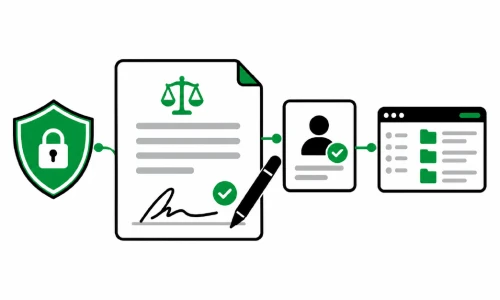
Document Signing is a fundamental element of contemporary legal practice. Law firms handle contracts, agreements, client forms, court documents, and a host of other files that require signatures. The time spent on printing, scanning and sending these documents may take more time and create more work for staff.
A secure eSign platform can help speed up this process and allow firms to keep documents organised and protected. But it’s not only speed that has legal teams worried. Security, identity verification, compliance and compatibility with existing legal software are also important considerations when choosing an eSign solution.
Security and identity checks to look for in a legal eSign platform
Legal documents may include private client information, financial information, business records, and other sensitive data. For choosing a platform, law firms need to go beyond just e-signatures.
A good legal eSign solution should have strong safety features and clear identity checks. Should also help companies control who can access documents and who can sign them. This can help to reduce common risks and give legal teams more confidence when handling important documents.
SOC 2 Certified eSign Tool: What Law Firms Should Ask Vendors
For law firms that put a high priority on information security, a SOC 2 certified eSign tool can be an important option. SOC 2 relates to controls concerning information security, availability and protection. Law firms should ask what security controls are in place and how customer data is handled when reviewing a provider. They also need to understand how documents are filed, secured, and retrieved. It’s worth looking at the provider’s security information rather than just choosing a service based on its basic signing capabilities.
Law firms should also inquire about how the platform manages user access and document activity. Audit records can help prove important actions, such as when a document was sent, opened, signed, or completed. Such a record could be useful when a firm needs to know the history of a document. Firms should also verify that the provider has sufficient security controls to meet their own policies and client requirements.
HIPAA compliant document signing: what to check before you sign
There are some law firms that deal with information related to healthcare issues. In such cases, privacy and data protection can be even more important. When documents contain protected health information, a HIPAA-compliant document signing solution may be considered. But companies should not assume that a platform is suitable just because it uses electronic signatures. They will want to look at the provider’s security practices, how they handle data, what their controls for access are, and their compliance information.
It is also important to understand the flow of sensitive information through the signing process. A firm needs to know where documents are kept, who has access to them, and how the provider secures them during the signing process. Legal teams should take a look at the provider’s current compliance information to see if it will work for their particular needs. This may help reduce confusion when dealing with documents that contain private health information. Before choosing a solution, firms can review XignDoc’s HIPAA-compliant document signing information.
Dual Factor Authentication eSign for Sensitive Legal Documents
A password by itself may not always be enough to protect sensitive legal files. Dual Factor Authentication eSign adds another layer of verification before a user can access or sign a document. For example, the second step might be a code sent to a trusted device. That means that if someone knows a password, they might still need the second verification method if they want to proceed.
This extra step can be useful if legal documents contain sensitive client information or important agreements. Law firms can choose where stronger authentication is most useful based on their internal security policies and the type of documents they handle.
It can also help lower the risk of passwords being stolen or shared. When organisations are evaluating an eSign platform, they want to know how authentication works and whether it’s available for a range of signing scenarios. XignDoc provides information about dual-factor authentication eSign options.
Identity verification for eSignatures before signing
Knowing who signs a legal document is just as important as getting the signature itself. Identity verification for eSignatures can add an additional layer of confidence to the signing process. Depending on the platform, identity checks can include a range of procedures to confirm the signer is the person they are supposed to be. The proper method will depend upon the type of document, the level of risk, and the needs of the firm.
Companies seeking legal eSign solutions can check out XignDoc’s identity verification for eSignatures features.
Fitting eSign into the legal software your firm already uses
Security is not the only factor when choosing an eSign platform. Law firms also need to consider how the tool will be incorporated into their existing daily work. Many companies are already using legal practice management systems, document management platforms and Microsoft-based tools. If an eSign platform is compatible with these systems, staff may spend less time moving files between different applications. With the right client or matter, a connected workflow can also make it easier to hold onto signed documents.
PracticePanther Electronic Signature: Fitting Signing into Your Workflow
PracticePanther Law Firms using PracticePanther may desire an e-signing solution that integrates effortlessly into their current workflow. PracticePanther’s electronic signature solution should make it easier to get documents out for signature without extra, unnecessary steps. When considering options, companies should consider how documents are created, transmitted, signed, and stored after completion.
The main goal is to decrease duplication of effort among attorneys and support staff. A connected process can cut down the time spent by staff to download files, upload them to another system, and manually organise completed documents.
Firms should also consider the integration and workflow options available before deciding. With the right setup, you can keep signing simple while giving legal teams the freedom to continue using the software they already know. XignDoc has legal-focused eSign information for firms who are looking for electronic signature option.
NetDocuments eSign Plugin: Keeping Signed Files with the Right Matter
Legal work is a large part of document management. Firms using NetDocuments need a simple way to keep completed documents organised with the right matter. A NetDocuments eSign plugin can help bridge document management needs with the signing process. Instead of viewing eSign as a chore to complete, companies can search for a solution that fits into their overall document workflow.
This can be especially helpful for a business that handles a lot of client agreements and documents. Staff members should not have to waste precious time searching for completed files or figuring out where a signed document should go. When comparing platforms, firms should ask how files are transferred, stored, and linked to the right matter. They should review security and control of access too.
iManage Digital Signature Tool: Signing Alongside Your DMS
Many legal teams use iManage to handle essential documents. An iManage digital signature tool can help make signing part of a wider document workflow for these firms. The important question is not just whether or not a document can be signed electronically, but what happens before and after signing. A smooth process means staff can easily prepare docs, send them out for signature, and handle completed files.
SharePoint Legal Document Signer for Microsoft-Based Firms
Many businesses and legal offices already use Microsoft tools to store and collaborate on documents. For these teams, it can be helpful to have a SharePoint legal document signer so signing fits into a familiar environment. The biggest benefit is that you keep document work connected instead of having a separate process for every signature request.
A professional eSign solution can cut down on unnecessary file transfers and make the signing process easy for lawyers and staff.
Smokeball Document Signing Alternative: A Platform-Independent Option
Not every law firm wants to be locked into one legal software platform. Some companies will want an eSign solution that provides them more flexibility across systems. For other options in security, identity checks, workflow, and software compatibility, firms can consider a Smokeball document signing alternative.
Considering an eSign plugin for your firm? Take a look at XignDoc’s legal solutions. Discover more about XignDoc’s eSign tool features and security approach.